
About Anita Johnson
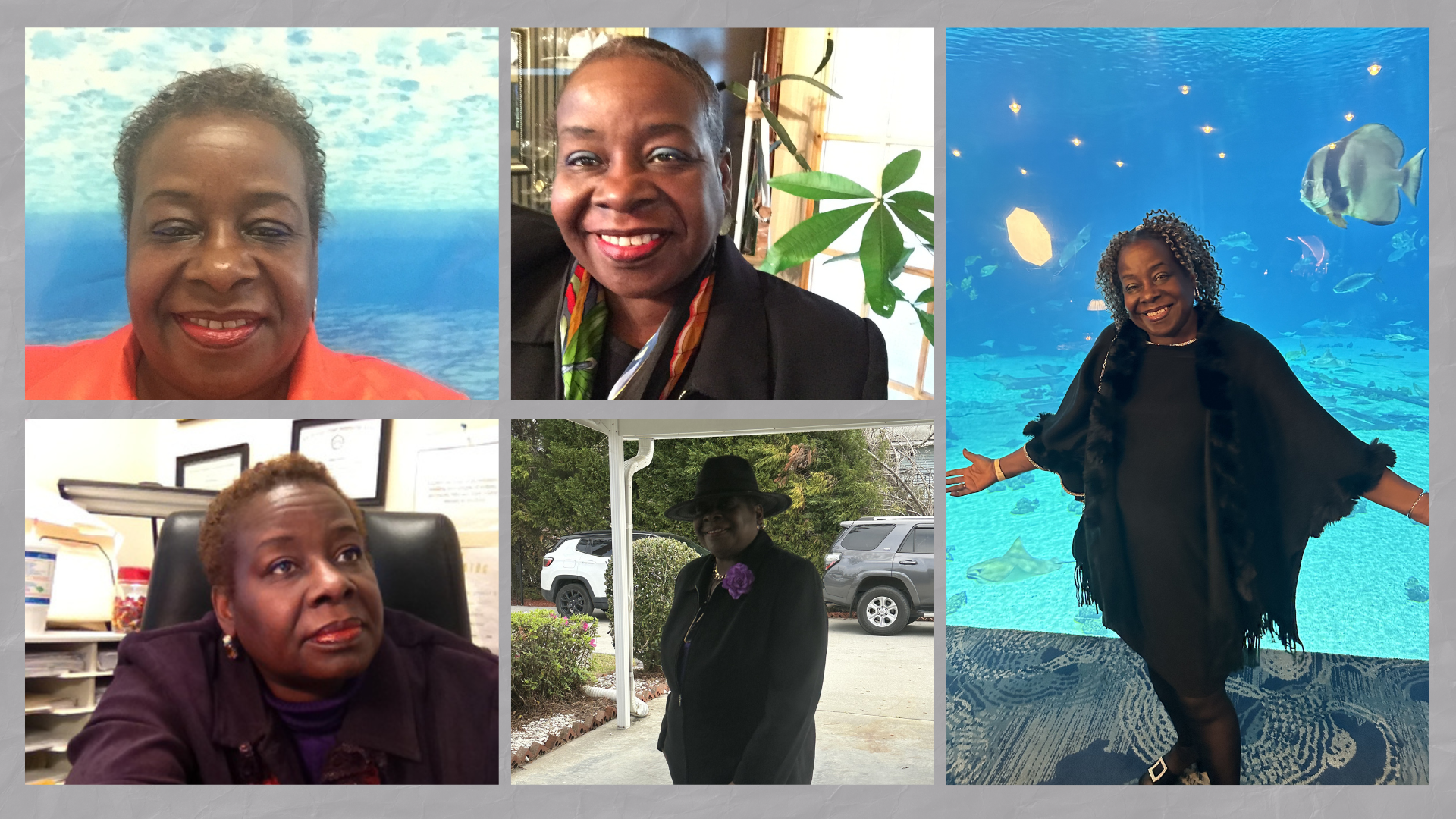
Anita (Kennerly) Johnson dedicated her career to public service, serving in a number of leadership roles, including Chief Probation Officer. Her work has also included involvement in restorative justice efforts and contributions to the public school system. Through both her professional achievements and civic engagement, she has remained deeply committed to strengthening and uplifting her community.
Anita holds an Associate of Science in Psychology from Atlanta Junior College (1982) and a Bachelor of Science in Criminal Justice from Georgia State University (1985).
Anita’s Perspective
My father became employed with the Alma Model Cities. The Lord will make a way out of no way. My father believed in sacrificing for his children. In Alma, Georgia, there were no accredited schools for Black children, so he and my mother sacrificed and sent my older siblings, Frances and Bettie, to Gillespie-Selden Institute in Cordele, Georgia. He and my mother educated four daughters:
Frances Kennerly (Clark Atlanta)
Bettie Greene (Florida A & M)
Bernita Lewis (Albany State University)
Anita Johnson (Atlanta Metro / Georgia State University)
1967 — The Year Things Changed
The year was 1967. My sister Bernita and I had finished the 5th grade at Alma Elementary School, the colored school in Alma, Georgia. We had gone to San Jose, California, to visit our older sisters Frances and Bettie. We had to cut the trip short because Grandma died. I remember her telling us that she would not see us again. She was scared for us to get on a plane. She said if God had wanted us to fly, He would have given us wings. After the death of our grandmother, our lives began to change.
My father, George Kennerly, sat us down at the kitchen table and told us we would not be going back to Alma Elementary School the next year. He said things were getting ready to change for us.
A man named Martin Luther King was standing up for Black folks, and we needed to be prepared.
On May 17, 1954, the justices of the Supreme Court decided that racial segregation of children in public schools was unconstitutional. That meant we could not be separated by race anymore. School segregation was against the law in America. Well, imagine my young mind trying to process this big idea. The justices had agreed in 1954, but it took until 1967 for it to reach us. It reminded me of Juneteenth.
I remember my father and mother talking about Brown v. Board of Education, which overturned Plessy v. Ferguson and declared that separate schools were inherently unequal. Daddy said we were going to use a tool called Freedom of Choice, so that our community would know where we stood.
It was our choice to go to white schools, not the government forcing us.
He said that by January of the next year, schools would be integrated anyway, so we might as well go ahead and get a head start. Bernita and I started school at Bacon County Primary School in September 1967. The rest of our community came later. We were scared and excited.
We got the opportunity to ride a school bus. We had never ridden one before because Alma Elementary School was across the street from our house.
We also had the chance to play on playground equipment. At Alma Elementary, we only had jump ropes, games scratched in the dirt, and hopscotch.
We played maypole and horseshoes, but we never had things like merry-go-rounds or monkey bars.
I thank God for four white girls, Pam Bournright, Aline Tucker, Holly Bennett, and Debbie Johnson, who were not afraid to open their hearts to Bernita and me. We are still friends to this day.
The Price My Father Paid
The pain came later when I realized the price my father paid. He had worked at Farmer’s Supply on 12th Street for years. When he made the decision to send his daughters to white schools, his employer, George Deen, was not pleased. He told my father that if he sent his children to white schools, he could consider himself unemployed.
My father chose to stand by his decision, even if it meant losing his job.
Because of that, we also lost our transportation. George Deen had allowed my father to drive one of the company trucks, and now he had to turn it in.
But God made a way. My father bought a __________.
Excerpt
“On May 17, 1954, the justices of the Supreme Court decided that racial segregation of children in public schools was unconstitutional. That meant we could not be separated by race anymore. School segregation was against the law in America. The justices had agreed in 1954, but it took until 1967 for it to reach us.”